AI Governance for Financial Services: A Practical Blueprint for UAE Chief Risk Officers
In recent years, risk and governance have risen to the top of executive agendas in financial services. According to a 2025 World Economic Forum report, nearly 60 percent of financial institutions identify governance and risk management as the most critical priorities for Artificial Intelligence (AI) deployment because these areas directly influence trust, compliance, and operational stability.
Artificial Intelligence (AI) has been part of financial services for many years, largely in the form of traditional, rule-based or predictive models used for fraud detection, credit scoring, and risk assessment. These systems operate within well-defined boundaries and are typically designed to produce consistent, explainable outcomes.
Generative AI (aka Gen AI), however, is a much newer development, emerging only in the past few years with the advent of large language models such as ChatGPT. Unlike traditional AI, Gen AI can generate new content, adapt dynamically to prompts, and produce outputs that are less deterministic. This blog post focuses specifically on Generative AI and its implications for financial services, where the ability of these systems to evolve and respond in unexpected ways makes setting clear standards, controls, and governance frameworks far more critical.
In the UAE context, this matters especially because local regulators, such as the Dubai Financial Services Authority (DFSA), the Financial Services Regulatory Authority (FSRA), and the Virtual Assets Regulatory Authority (VARA), expect institutions to manage operational, compliance, and fair treatment risks with the same diligence as traditional financial activities. And now with the advent of Gen AI, there’s a horde of new opportunities and new kinds of risk that Chief Risk Officers (CROs) must manage carefully.
What AI Governance Means in Financial Services
AI governance refers to a structured set of policies, processes, and controls that ensure AI tools are safe, fair, reliable, and compliant with regulations. This is not the same as general financial governance, which focuses on areas such as financial reporting, internal controls, and fraud prevention.
Traditional financial governance makes sure that financial statements are accurate and that the institution remains stable. By comparison, AI governance is specifically about responsible use of data and models with decision-making capabilities that can influence customer outcomes, operational results, or regulatory reporting.
Put simply, financial governance ensures the business is stable and well managed, whereas AI governance ensures that advanced systems behave in ways that do not introduce new uncontrolled risk. Weak AI governance can cause wider financial governance failures if incorrect models lead to flawed decisions.
Core Components of a Governance Framework
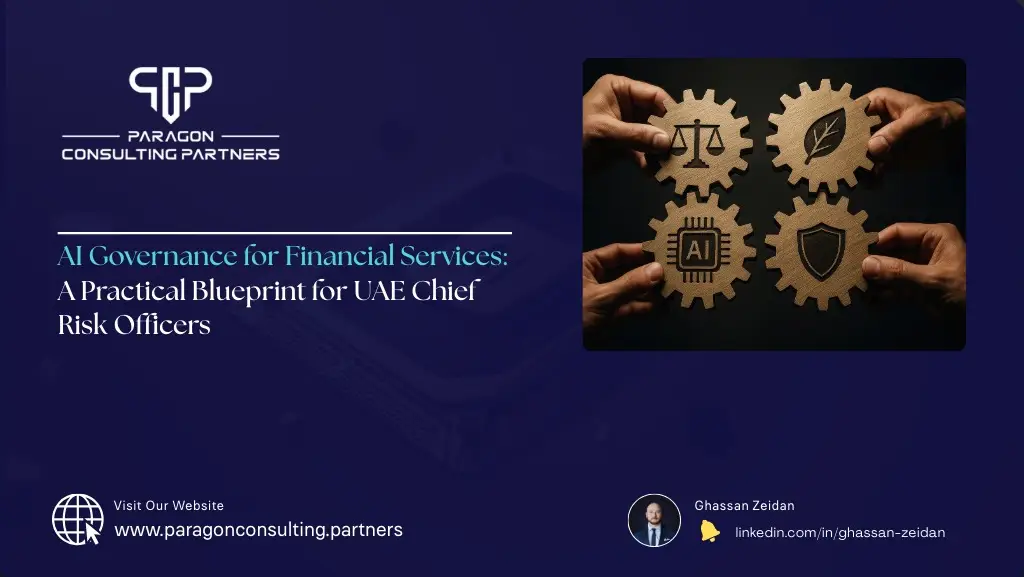
A practical AI governance framework for financial services has several key components that a CRO needs to put in place.
The first component is clear policies. These policies define expectations for fairness, accuracy, transparency, and compliance across every AI system used by the institution. Policies help ensure that AI work follows common principles.
A second component is roles and responsibilities. A governance structure must explain who is responsible for approving AI models, who checks their performance, and who reports issues to senior management or regulators. In the UAE, institutions can map these responsibilities to existing reporting lines to audit committees and risk committees, which are already part of the corporate governance ecosystem.
Next comes risk assessment. This involves identifying specific AI uses and evaluating their potential impact on customers, operations, and regulatory obligations. For example, AI applied in credit scoring needs careful examination to detect bias or unfair treatment, especially under UAE anti-discrimination expectations. Assessments also help determine whether models respect privacy and align with data security laws.
Finally, control mechanisms give the institution tools to pause, adjust, or retire models that show unexpected behavior or drift from acceptable performance. This requires continuous checks and reporting on model performance over time. A robust framework connects policies, responsibilities, assessments, and controls so that issues are caught early before they have serious consequences. Ultimately, this comes down to governing inputs and outputs through clear safeguards that keep models operating within defined and acceptable boundaries.
AI Governance Challenges CROs Must Address
CROs face several governance challenges as AI adoption expands across financial services. Each of the issues listed below requires devoted attention, clear ownership, and practical controls to avoid compliance gaps or operational strain.
1. Evolving Regulatory Expectations
Regulatory guidance on AI continues to change at both global and regional levels. Therefore, it’s imperative that financial institutions track updates from international standard setters, and also align with DFSA, FSRA, and VARA. Otherwise, their delayed responses to regulatory change will expose them to compliance findings or supervisory scrutiny.
2. Fragmented Accountability Across Stakeholders
AI governance involves risk teams, compliance officers, technology teams, legal advisors, and business leaders. But when roles are not clear, decisions take longer because no one knows exactly who should act. Tasks get passed around, and it becomes hard to hold anyone responsible. Sometimes, conflicting priorities also delay approvals or create gaps in oversight.
3. Legacy Systems and Technical Complexity
Unfortunately, many financial institutions still depend on legacy systems that were not designed for advanced analytics or AI integration. These systems create technical debt that complicates model updates and data validation. As a result, changes take longer and cost more, which increases operational risk. Governance frameworks must account for system limitations and include realistic timelines for remediation.
4. Skills Gaps and Knowledge Imbalance
Effective AI governance requires both technical understanding and risk awareness. Many organizations struggle to find talent that bridges data science, regulation, and business operations. In the absence of a common understanding of the fundamentals, conversations about governance either stay basic or get lost in technical language that only few can grasp.
5. Documentation and Audit Trail Challenges
Regulators expect clear records of how AI systems are designed, approved, and monitored. Weak documentation makes it difficult to explain decisions or demonstrate compliance during audits. When records are all over the place, it becomes hard to trace why a model made certain recommendations, who approved those choices, what testing was performed, and how any issues were resolved, which can leave gaps during internal reviews or regulatory inspections.
Best Practices for Effective AI Governance
Strong AI governance depends on practical actions that guide how teams design, review, and operate AI systems. Consider implementing these best practices.
1. Form cross-functional governance teams.
Strong AI governance works best when responsibility does not sit with one function alone. Leadership teams should include representatives from business units, technology, legal, compliance, and risk management. Bring these groups together early so decisions reflect operational reality, regulatory expectations, and technical limits. Clear ownership across functions reduces confusion and prevents gaps in accountability.
2. Invest in continuous training and awareness.
AI governance depends on people who understand both technology and regulation. Ensure teams receive regular training on model risks, data governance, and supervisory expectations. Encourage business and risk leaders to build a working knowledge of how AI systems behave. Shared understanding helps teams raise issues early and respond appropriately during reviews or inspections.
3. Keep a prompt library for consistent usage of Gen AI.
Keep a shared prompt library so teams are not starting from scratch each time they use Gen AI, and so there is a clear reference point for how these tools should be instructed across the organization. It helps bring consistency to model behavior, which in turn makes outputs easier to predict, review, and explain. For example, approved prompts can guide responses in common business scenarios and reduce unnecessary variation. As usage expands, prompts can be updated, versioned, or retired, making it easier to manage risk and apply clear safeguards to both inputs and outputs.
4. Use back testing to validate AI outputs.
Run your AI outputs against historical data to see how the model would have behaved in real-world scenarios and under different conditions. This back testing will help reveal hidden risks, bias, or inconsistencies that may not be obvious in forward-looking assessments. It also allows teams to compare AI-driven decisions with actual past outcomes and established benchmarks. In doing so, it becomes easier to understand why certain outputs were generated and where controls may be needed. As a result, teams can refine assumptions, adjust thresholds, and confirm that outcomes remain aligned with risk appetite and regulatory expectations.
5. Maintain detailed documentation across the AI lifecycle.
Documentation is an important aspect of effective governance. Make it mandatory for your teams to record model objectives, data sources, design decisions, validation results, and performance outcomes. Then keep these records updated as models evolve or controls change. Clear documentation ensures that internal audits, regulatory reviews, and senior management oversight run efficiently and capture all steps accurately.
6. Apply structured change management.
Governance frameworks only work when people accept them. Introduce new AI controls through clear communication and realistic timelines. Explain why governance matters and how it supports better outcomes rather than slowing progress. When teams understand expectations, adoption improves and resistance declines across the organization.
7. Measure governance performance with clear metrics.
Governance should show tangible results. Track compliance with internal policies and external regulations, monitor audit findings linked to AI systems, and record response times for incidents or model issues. Use these indicators to review effectiveness and refine controls. Measurement turns governance into an active management tool rather than a static checklist.
8. Engage professional regulatory and governance advisors.
AI regulations change quickly, and internal teams may not always keep pace. Engage experienced advisors who understand UAE regulatory environments and international standards. Use their insight to interpret guidance accurately and design controls that stand up to regulatory scrutiny. Independent advice also adds credibility and strengthens assurance for boards and regulators.
Partner With Us
Paragon Consulting Partners works with financial institutions operating in the DIFC, ADGM and VARA to design and implement AI governance frameworks that align with UAE regulatory expectations.
Our advisors help firms interpret local guidance, integrate all regulatory requirements, and map international standards into daily operations. Our spectrum of service covers governance structure design, policy development, risk assessments, audit readiness, and more!
Above all, by combining regional rules with international governance knowledge, we help firms use AI responsibly and uphold strong control, full transparency, and compliance with UAE’s regulatory requirements.